Overview
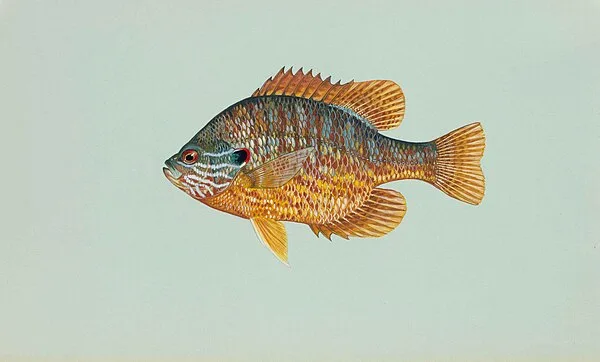
The pumpkinseed is one of the most visually striking members of Michigan’s sunfish family. Its body is covered in a mosaic of orange spots, blue-green wavy lines on the cheeks, and a distinctive red or orange crescent marking on the ear flap that makes it easy to identify. While less targeted than bluegill by most anglers, pumpkinseed are well-established across Michigan’s thousands of inland lakes and provide a welcome bonus for panfish anglers.
Pumpkinseed prefer clear water with abundant aquatic vegetation — conditions found in many of Michigan’s natural glacial lakes. They are closely related to bluegill and occupy similar habitats, though pumpkinseed tend to stay in shallower, weedier water and are more tolerant of dense vegetation than most other sunfish.
Where to Find Them in Michigan
Michigan’s natural lake country is prime pumpkinseed habitat, with fish found in both the Upper and Lower peninsulas.
Northern Lower Peninsula: The thousands of glacial lakes scattered across the northern Lower Peninsula hold strong pumpkinseed populations. Lakes in the Traverse City, Petoskey, and Grayling areas — including Torch Lake, Elk Lake, Lake Charlevoix, Mullett Lake, and Hubbard Lake — all support pumpkinseed mixed in with bluegill and other panfish. Lake Leelanau and Lake Mitchell near Cadillac are also productive.
Upper Peninsula: UP lakes including Lake Gogebic in Ontonagon County, Manistique Lake in Luce and Mackinac counties, and Indian Lake in Schoolcraft County hold healthy pumpkinseed populations. UP boundary waters are open to panfish year-round with a generous daily limit of 25 sunfish in any combination.
Southern Lower Peninsula: While pumpkinseed are less abundant in the south, they are present in many natural lakes. Lake Nepessing in Lapeer County produced the current state record of 2 pounds 2 ounces in 2009. Union Lake in Oakland County and Houghton Lake in Roscommon County also support pumpkinseed.
Look for them along weed edges, in lily pad fields, and around submerged vegetation in 2 to 6 feet of water. They favor sandy or mucky bottoms with emergent plant growth nearby.
Techniques
Simple bobber fishing is the most effective approach. Use a light or ultralight rod with 4-pound monofilament, a small bobber, and a size 8 or 10 hook baited with a wax worm, small piece of nightcrawler, or cricket. Set the bobber 2 to 4 feet deep and fish along weed edges or in openings within weed beds.
Micro jigs in the 1/64- to 1/32-ounce range, tipped with wax worms or small soft plastics, are deadly when worked slowly through vegetation. Tube jigs in natural colors — brown, green, and watermelon — imitate the small invertebrates pumpkinseed feed on.
Fly anglers can target pumpkinseed effectively with small nymphs, wet flies, and poppers in sizes 10 through 14. Hare’s ear nymphs and small wooly worms work particularly well fished along weed lines.
Tips
Pumpkinseed spawn from late May through June when water temperatures reach the upper 60s. Males build nests in sandy or gravelly shallows, often in colonies alongside bluegill. During this period, they are concentrated and aggressive, making it the best time to catch numbers.
Through summer, pumpkinseed tend to hold slightly shallower than bluegill in the same lake, staying tight to weed cover. Fish the inside weed edges in 2 to 5 feet of water rather than the deeper outside breaks. They feed throughout the day but are most active during the first few hours after sunrise and the last hour before sunset.
In winter, pumpkinseed are a popular ice fishing target on Michigan lakes. Small jigs tipped with wax worms or spikes, fished in 4 to 8 feet of water near weed beds, produce consistent catches through the ice. They remain active feeders in cold water and often bite when bluegill go dormant.