Lake Sturgeon in Michigan
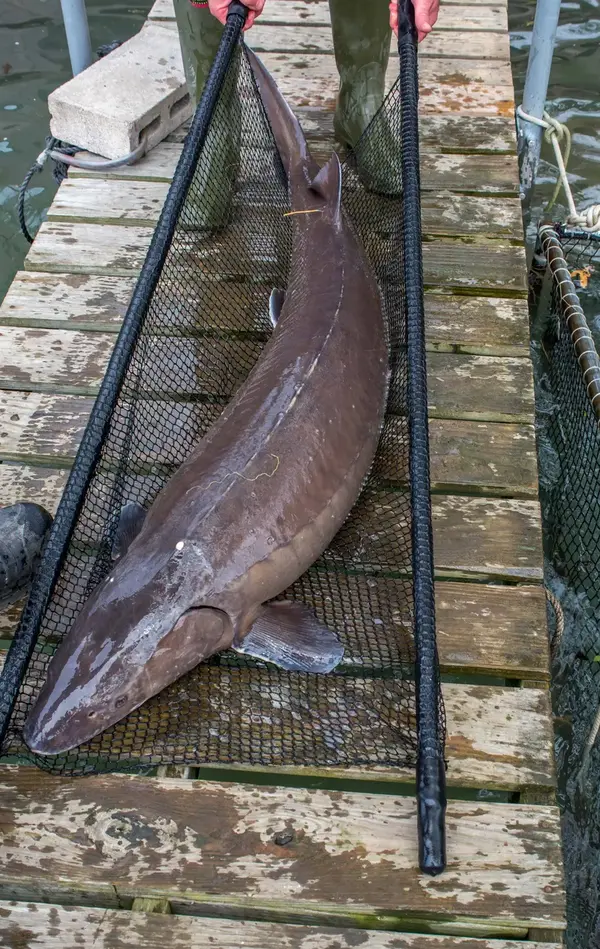
The lake sturgeon is a living fossil — a prehistoric fish that has survived virtually unchanged for 150 million years. Michigan’s lake sturgeon populations are a conservation success story, with DNR restoration efforts bringing this threatened species back from the brink in several watersheds. The state record is a 193-pound, 88-inch specimen speared by Joseph Maka in Mullett Lake on February 16, 1974. But that may not even be the biggest — in 2021, DNR biologists caught and released a 240-pound female in the Detroit River, nearly 7 feet long, believed to be among the largest lake sturgeon ever recorded in the United States. While most sturgeon fishing in Michigan is catch-and-release, the opportunity to hook and fight a fish that predates the dinosaurs makes it a bucket-list experience.
Identification
Lake sturgeon are unmistakable — they have a shark-like body with bony plates (scutes) along their sides and back instead of scales, a long snout with four barbels (whiskers) on the underside used to detect food on the bottom, and a heterocercal tail (upper lobe longer than lower). Young sturgeon have sharper scutes and more distinct markings; older fish become smoother and more uniformly gray-brown. They are bottom feeders with a protrusible, toothless mouth.
Where to Find Lake Sturgeon
Detroit River and Lake St. Clair hold one of the healthiest sturgeon populations in the Great Lakes basin. The Fighting Island spawning reef and the channels around Belle Isle are hotspots. This is where DNR biologists caught the 240-pound female in 2021 — proof that Michigan’s restoration efforts are producing fish of truly historic proportions.
Black Lake (Cheboygan County) is Michigan’s most famous sturgeon water. The annual spawning run up the Upper Black River draws national attention, and the lake hosts a limited winter harvest season — one of very few in the state.
Burt Lake and Mullett Lake (Cheboygan County) are connected to the Cheboygan River system and support sturgeon populations that move between the lakes and rivers.
Menominee River on the Michigan-Wisconsin border is another strong sturgeon fishery with accessible shore fishing.
Techniques
Lake sturgeon are exclusively bottom feeders. The primary technique is still-fishing on the bottom with heavy tackle — a sturdy rod, 30-50 pound test line, a heavy sinker to hold bottom in current, and a circle hook baited with nightcrawlers, cut bait, or crayfish. Patience is key — sturgeon fishing involves long waits between bites, but when a 50-pound fish picks up your bait, the fight is unforgettable. Always use barbless hooks and handle sturgeon with wet hands to protect their slime coat.